
“The Black Cyclone of Wooster”
By
Andrew DeMarco
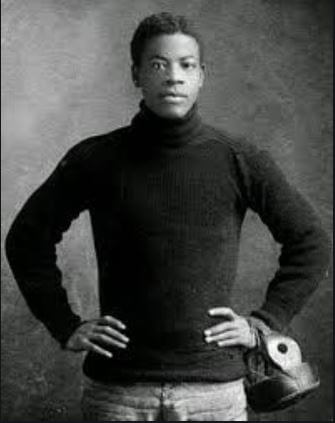
With February being Black History Month, I will once again tell the story of a lesser known African American. This year I have chosen to write about Charles Follis.
Charles W. Follis was born on February 3, 1879, the third of seven children born to James Henry and Catherine Matilda Anderson Follis in Cloverdale, Virginia. Charles W. Follis’ father was a farm laborer. In 1885 the family would move to Wooster, Ohio where in 1901 Charles entered Wooster College. At that time there was no NFL as we know it today. Rather there was a group of Athletic Associations and they each had their own football clubs. Charles had the opportunity to play football for his Wooster College team but instead chose to play for the Wooster Athletic Association. It was there that he would earn the nickname The “Black Cyclone of Wooster.” In a two game season series against the Shelby Blues, Charles caught the attention of Frank Schiffer, the Shelby manager who signed him to a contract in 1902. During his time with Shelby, he was sometimes the object of rough tactics from opposing players and ridiculed by fans in towns and cities visited by the Shelby team. One of his teammates on the Shelby team was Branch Rickey, who was often hired to play for Shelby while attending nearby Ohio Weslyan University.
But football wasn’t the only sport that Charles excelled at. He also played baseball at Wooster College where he was a catcher during the 1901 and 1902 seasons. Charles became well known in the Ohio college circuit. His closest rival at that position was his Shelby Blues football teammate Branch Rickey. After an injury ended his football career in 1906, Charles would later go on to catch in 1909 for the Cuban Giants of the Negro Leagues where he was, their leading slugger and their most popular player.
In a strange twist, it wasn’t until 1975 that Charles’ place in football history and a piece of his legacy came to light. While researchers were reviewing the accomplishments of Charles on the football field, they came across a contract from 1904 signed by Charles and the Shelby Blues thus making Charles the first African American professional football player.
In yet another twist, it is highly probable that Branch Rickey’s firsthand observation of Charles’ handling of prejudice, on the field and off, influenced his decision to introduce Jackie Robinson to major league baseball, just as he had watched Frank Schiffer introduce Charles Follis to professional football some 40 years earlier.
Unfortunately, Charles would never learn of his legacy and indirectly his contribution to baseball. He died in Cleveland on April 5, 1910, after developing pneumonia after playing a game with the Giants he was 31 years old. He is buried in Wooster Cemetery in Wooster, Ohio.
You have to wonder how much more Charles could have accomplished and contributed to history had he not died at the age of 31. But knowing his contributions and his place in football history gives me that feeling that Cousin Bob would call that…..Rosy Glow!

 Bob's Rosy Glow